
Three questions for your plant
- Has your plant defined its state of maximum efficiency? Truly defined: in writing, with the ideal behavior of the process variables.
- If so, do you know how long it stayed there last month?
- And if you know that, do you know how much the rest of the time cost you?
Very few plants can answer all three. A production setpoint is different from a state of maximum efficiency, and the second question usually reveals a goal that has yet to be measured. Firma Operativa answers all three for each asset: what the good state is, how long the plant stayed there and how much the rest of the time cost.
What Firma Operativa is
Firma Operativa (operational signature) is Summan's solution that uses machine learning on process history to identify the operating states of an industrial asset and measure how long it spends in each one, what each one costs and where it tends to move.
A production plant is genuinely complex: dozens of variables affecting each other, changing conditions and varying material. Those signals are usually looked at separately, which is why a plant can have thousands of data points and still lack a shared explanation of why it loses stability, energy or capacity.
The key is to organize that complexity. The same signals, related to each other, form configurations that repeat. Each one is an operating state. With the states in view, complexity can be named, measured and compared.
How it works
- A single signal says little. If throughput goes up, is that good? It depends on what power, cyclone pressure and product fineness are doing at the same time.
- Related, the signals tell the story. When several move in a certain way at the same time, they form a recognizable configuration that repeats and has consequences: an operating state.
- The algorithm finds them; the plant names them. States emerge from the process history without telling the algorithm what to look for. Plant engineers then recognize, validate and name them.
- Four new answers appear about the operation:
| Question | What it shows |
|---|---|
| Which state am I in, and for how long? | The current state and how long it lasts |
| What is this state costing me? | Its impact on the operation compared with the reference state |
| Where is the process heading? | Which states it tends to move to from the current one |
| What usually comes before this? | Where it came from each time it got here |
What you see in the dashboards
These dashboards belong to a ball mill. The figures are illustrative and show the kind of reading Firma Operativa delivers.
The state of the operation, now
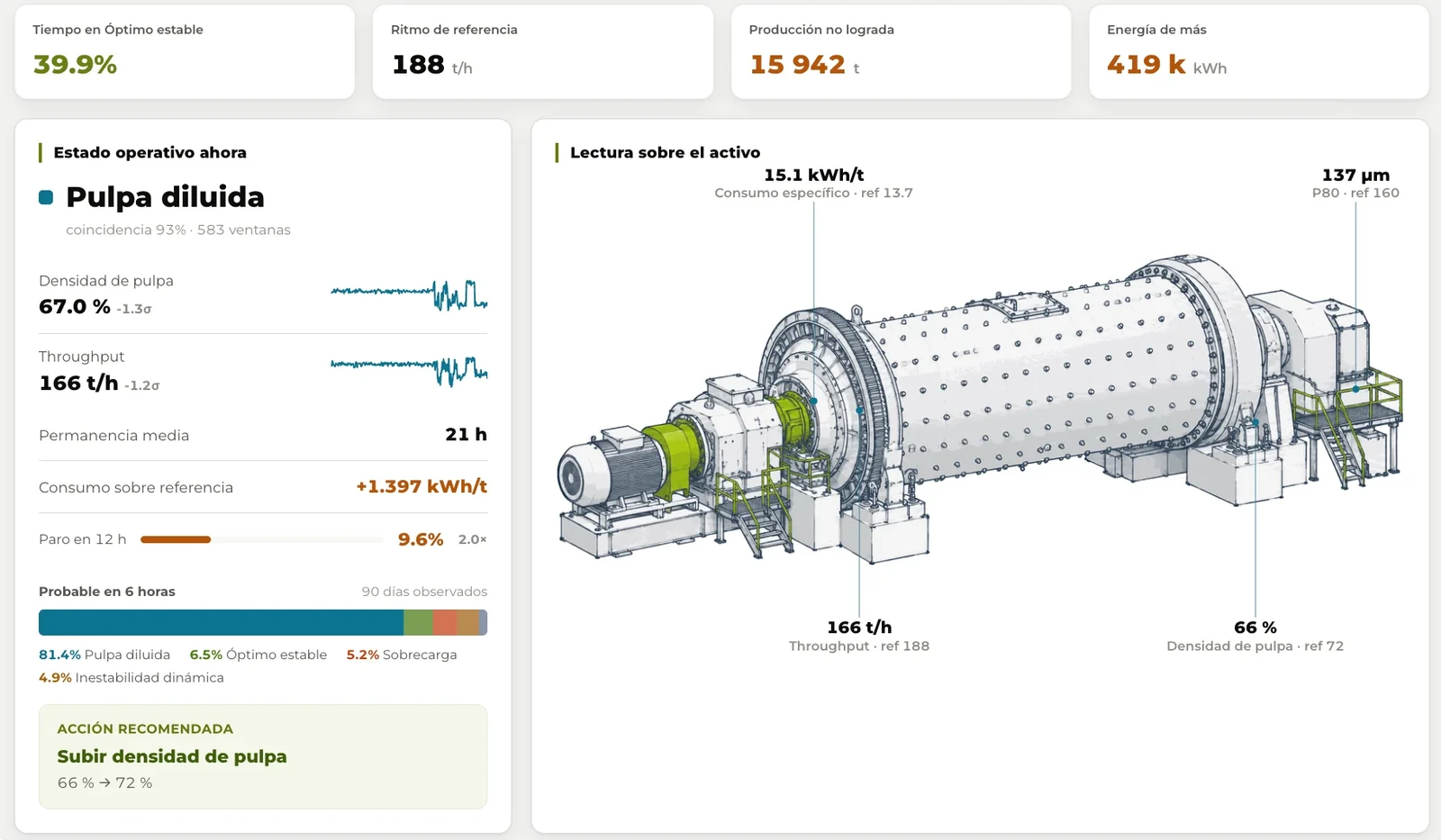
In a single view: which state the asset is in, how long that state usually lasts, which variables explain it, what it is costing compared with the reference operation and which action is recommended to return to the good state.
The signature of each state
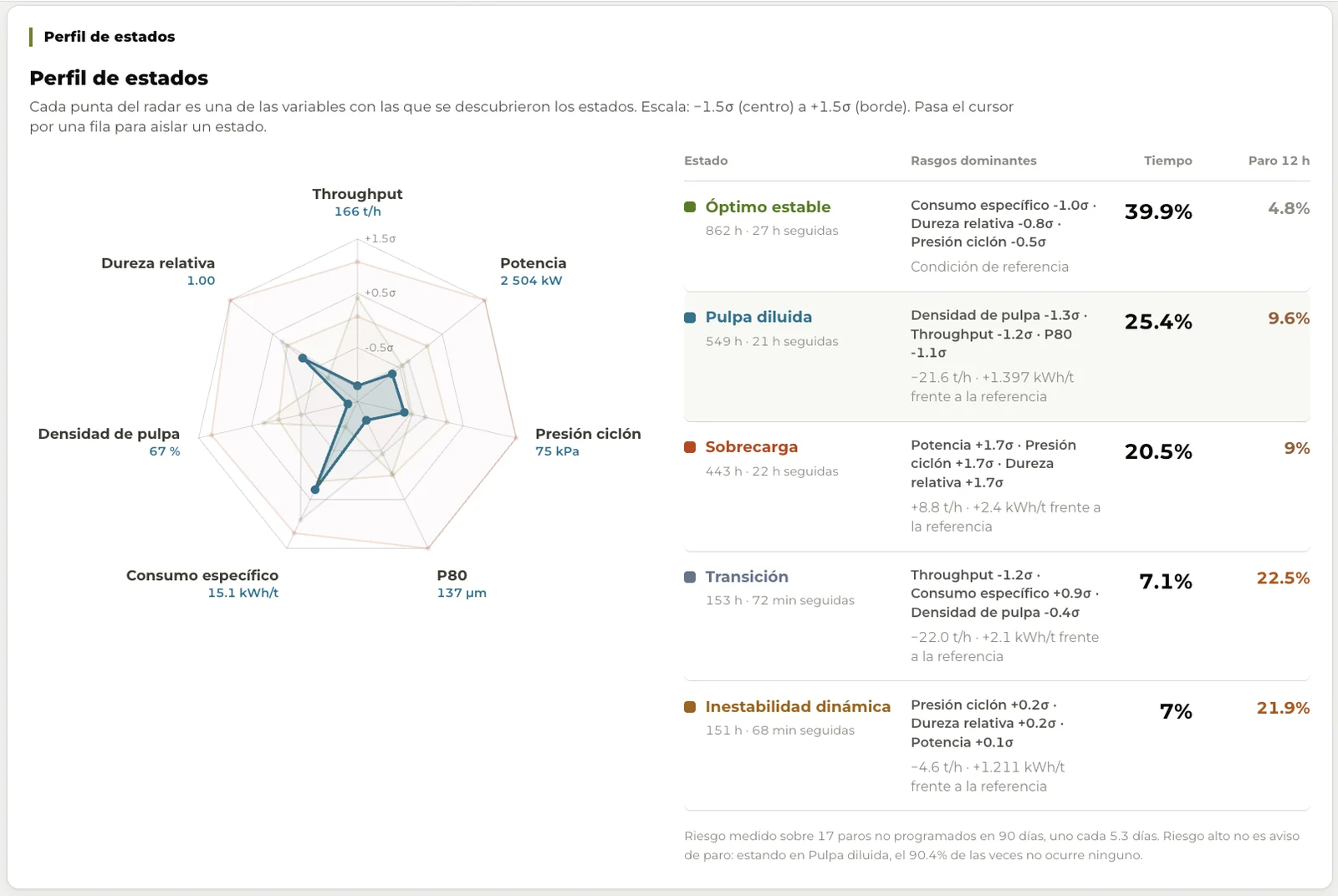
Each state leaves a recognizable footprint on the process variables: its signature. Here you can see what sets each one apart, how much time the plant spends in it and how closely it is associated with unplanned stoppages.
From insight to autonomy
In the base scope, Firma Operativa reads, characterizes and recommends; decisions remain with the operation. The destination is a closed loop, where the digital twin acts on the plant with more autonomy, and it is reached step by step:
- The model describes and the plant verifies.
- The model recommends and a person decides.
- Once trust has been earned, the closed loop is designed, with testing, change management and explicit operational authority.
This path is the same as the Journey to Digital Twin.
Frequently asked questions
Is Firma Operativa just clustering?
It goes beyond grouping data: the hard and valuable part is making each state mean something to the plant. Our method considers both the level and the behavior of the variables over time, and the result is always recognized, named and validated by the operations team.
How do I know the states are real?
When your engineers recognize them. That validation step is part of the method. If a state is hard to recognize, it may be a model artifact or a real finding worth looking into; both cases are reviewed with the team.
What if my data has quality issues?
That is common, and solving it is part of the work. What is essential is having the context that explains the operation; we review it from the start, together with your team.
Does it generate alarms?
Firma Operativa shows which state the system is in; it is a condition reading. A state lasts hours, so the reading is stable. When it shows risk, it also shows how many times that state occurred without consequences.
Does it replace the operator?
It gives the operator what today only someone with fifteen years in the control room has. Experienced operators already recognize these states by intuition; Firma Operativa makes that judgment explicit so it holds across every shift and stays with the organization.
I already have SCADA and BI dashboards. What does it add?
A different layer. SCADA answers "how is this variable doing?"; Firma Operativa answers "which state is the system in, what is it costing me and where is it heading?". It works on top of the installed base, in read-only mode.
Does it write to the PLC or the control system?
In the base scope, the system reads, characterizes and recommends, and decisions stay with the operation. Any write to PLCs, DCS or actuators requires a separate design, testing, change management and explicit operational authority. The closed loop is the destination and is reached step by step, once the plant trusts what the model says.
Is it predictive maintenance?
It is complementary and feeds it. Predictive maintenance looks at the equipment ("will this bearing fail?"); Firma Operativa looks at how it is being operated. Inefficient and unstable states are precisely the ones that precede failures, and it also reveals something predictive maintenance misses: healthy equipment being operated poorly.
Does it use artificial intelligence?
Yes: machine learning, a branch of artificial intelligence, to find the patterns. And everything on screen can be explained and traced back to operating data, because in a plant a number nobody can explain goes unused.
Is it a real digital twin?
Yes. It guarantees two things: high fidelity, because the models explain the real behavior of the operation in physical and mathematical terms, and synchronization, because the representation stays up to date with the process. It can start with historical analysis, before an online connection exists.
Updated: