
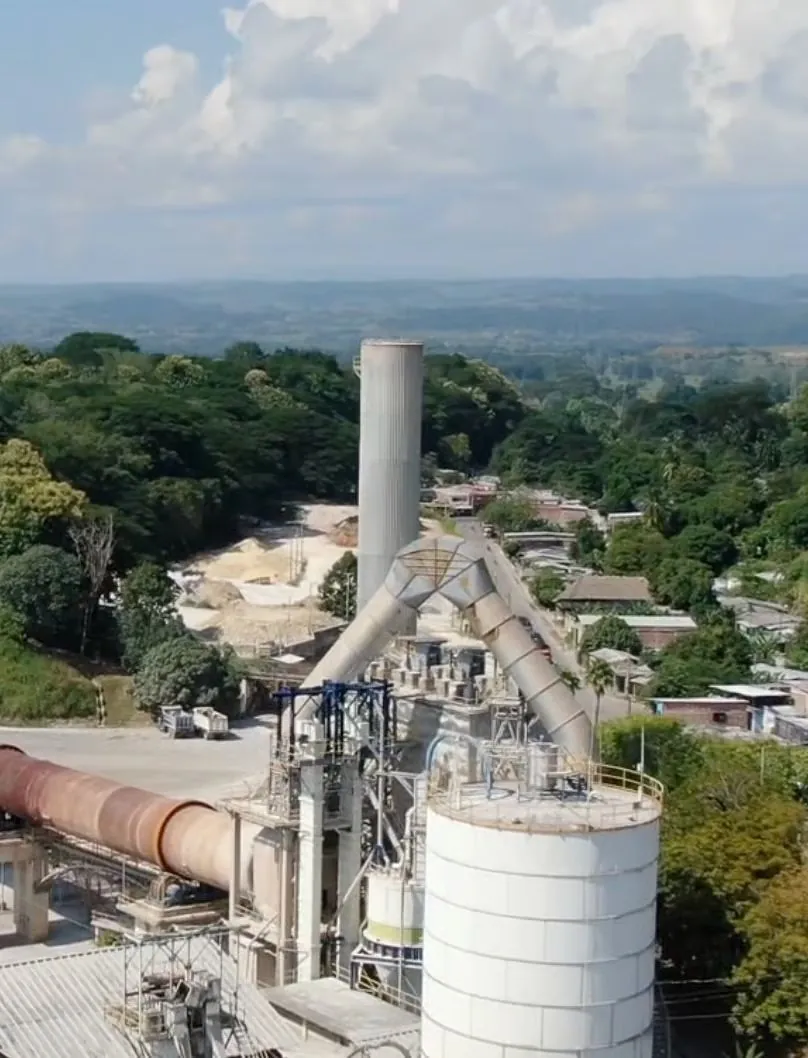
What is a digital twin?
A digital twin is a virtual replica of a process, piece of equipment or plant that is continuously fed with real operating data: IoT sensors, control systems (DCS, PLC, SCADA), plant historians and production systems. Analytical and machine learning models built on that data make it possible to understand what is happening, anticipate what will happen and recommend how to adjust the process for the best result.
Unlike a traditional simulation, which runs once on fixed assumptions, a digital twin stays synchronized with the real operation and learns as the plant changes.
What a digital twin does for industry
- Optimize process variables in real time to produce more with the same installed capacity.
- Compensate for raw material variability, one of the biggest challenges in cement and mining.
- Reduce energy consumption and emissions per ton produced.
- Predict product quality before it leaves the process, instead of waiting for lab results.
- Simulate scenarios ("what if I change this variable?") while the plant keeps operating normally.
- Support operators with clear, data-driven recommendations.
Case study: Cementos Argos
We implemented a digital twin that virtually replicates the cement production process to compensate for the natural variability of raw materials and ensure every batch meets the required strength. The project received the 2022 Portafolio Award for Digital Transformation in Colombia.
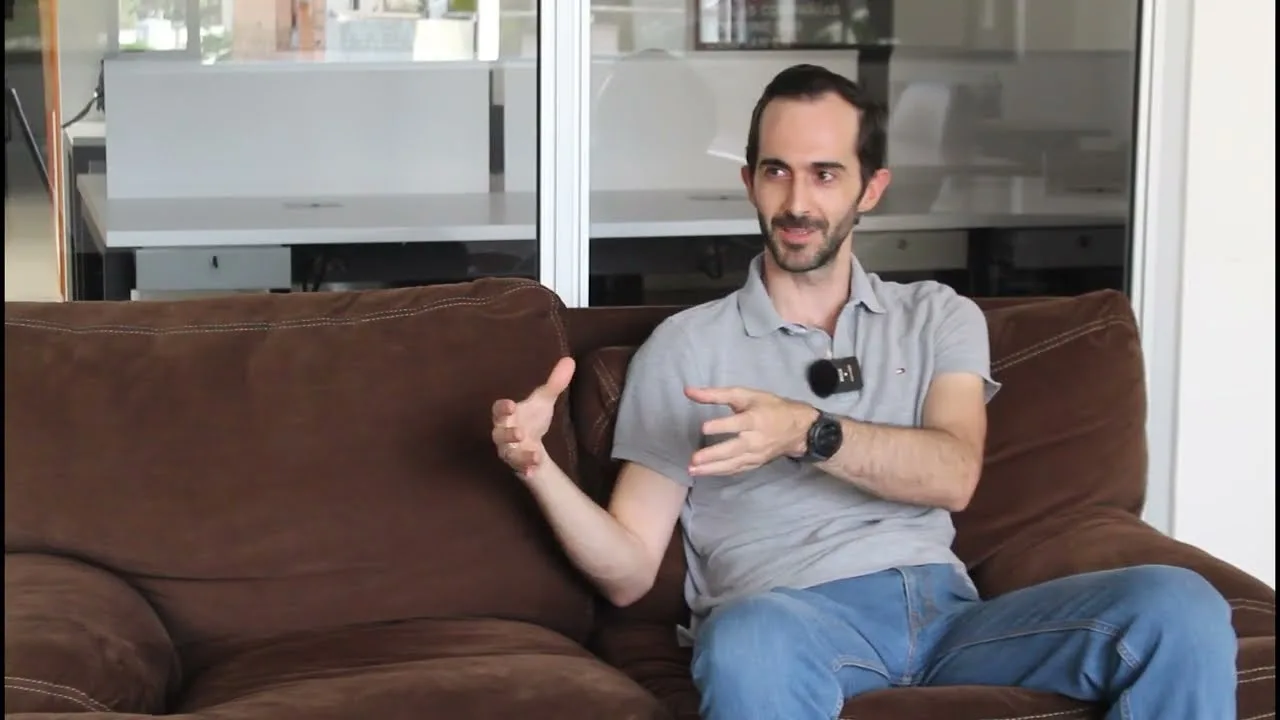 7:10
- USD 12M+annual savings
- 0.61 kWh/tlower energy consumption
- 2–4%lower emissions
- 2–3%higher production
See the full Cementos Argos case study
Journey to Digital Twin
Our methodology is a continuous flow: it takes the organization step by step from diagnosis to operational autonomy, and from there starts again with new processes. Along the way, the twin matures from Digital Model to Digital Shadow to Digital Twin. Each phase is validated before moving to the next, and we only move online once the Assessment identifies high-potential use cases with enough data to support them.
Mineros S.A.'s experience with the assessment (phase 01):
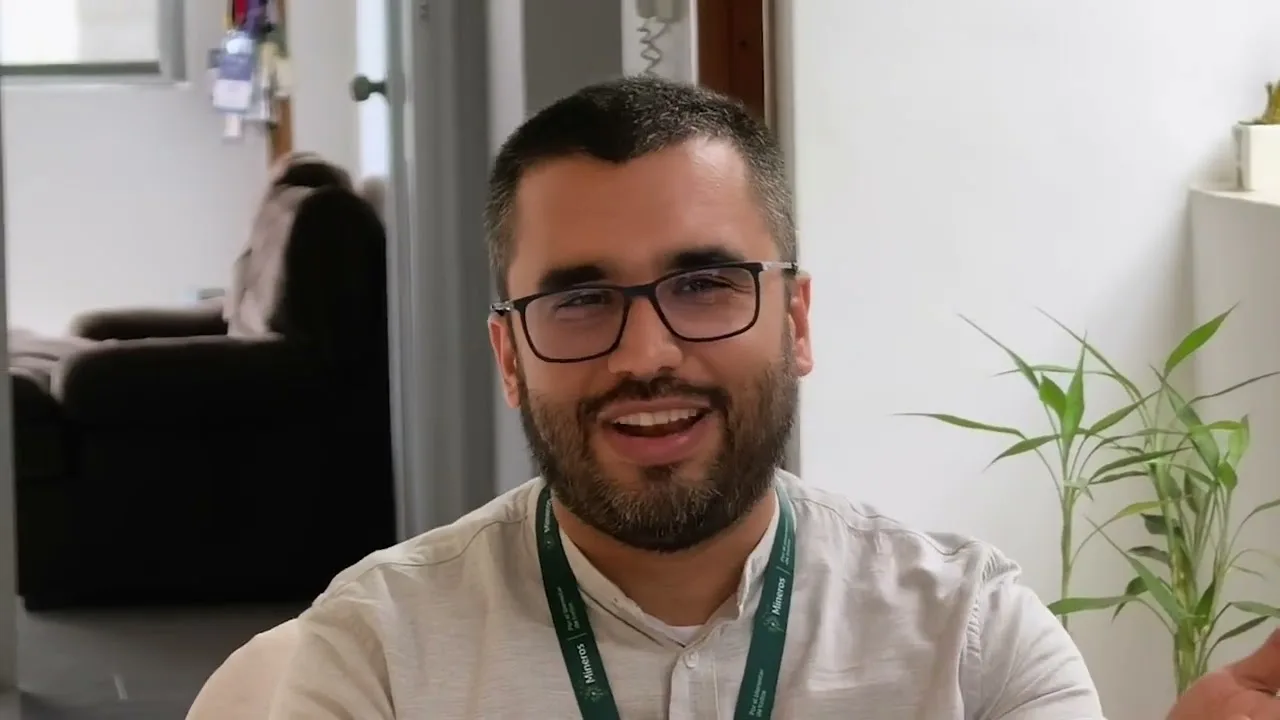 14:58
- Digital ModelPhases 01–02 · Strategy and offline prototype
- Digital ShadowPhases 03–04 · Online and bidirectional validation
- Digital TwinPhases 05–06 · Autonomy and predictive control
Phase 01: Strategic definition (Assessment)
Digital maturity diagnosis, process map, use case prioritization and roadmap.
Phase 02: Functional prototype
Analytical model for the priority use case and a business case with projected return.
Phase 03: Online integration
The twin connected to plant data in real time.
Phase 04: Operational validation
Recommendations in operation and impact measurement.
Phase 05: Operational autonomy
Systems operating with minimal intervention and benefits realized.
Phase 06: Continuous evolution
Continuous improvement and expansion to new processes.
Firma Operativa
Firma Operativa (operational signature) connects the dozens of signals your plant already measures, which today are looked at separately. From that relationship emerge the operating states: process configurations that repeat and have consequences. With them, the complexity of the operation becomes a clear reading: which state it is in, what it is costing you and where it is heading.
Three questions for your plant:
- Has it defined its state of maximum efficiency, in writing, with the ideal behavior of its variables?
- Do you know how long it stayed there last month?
- Do you know how much the rest of the time cost you?
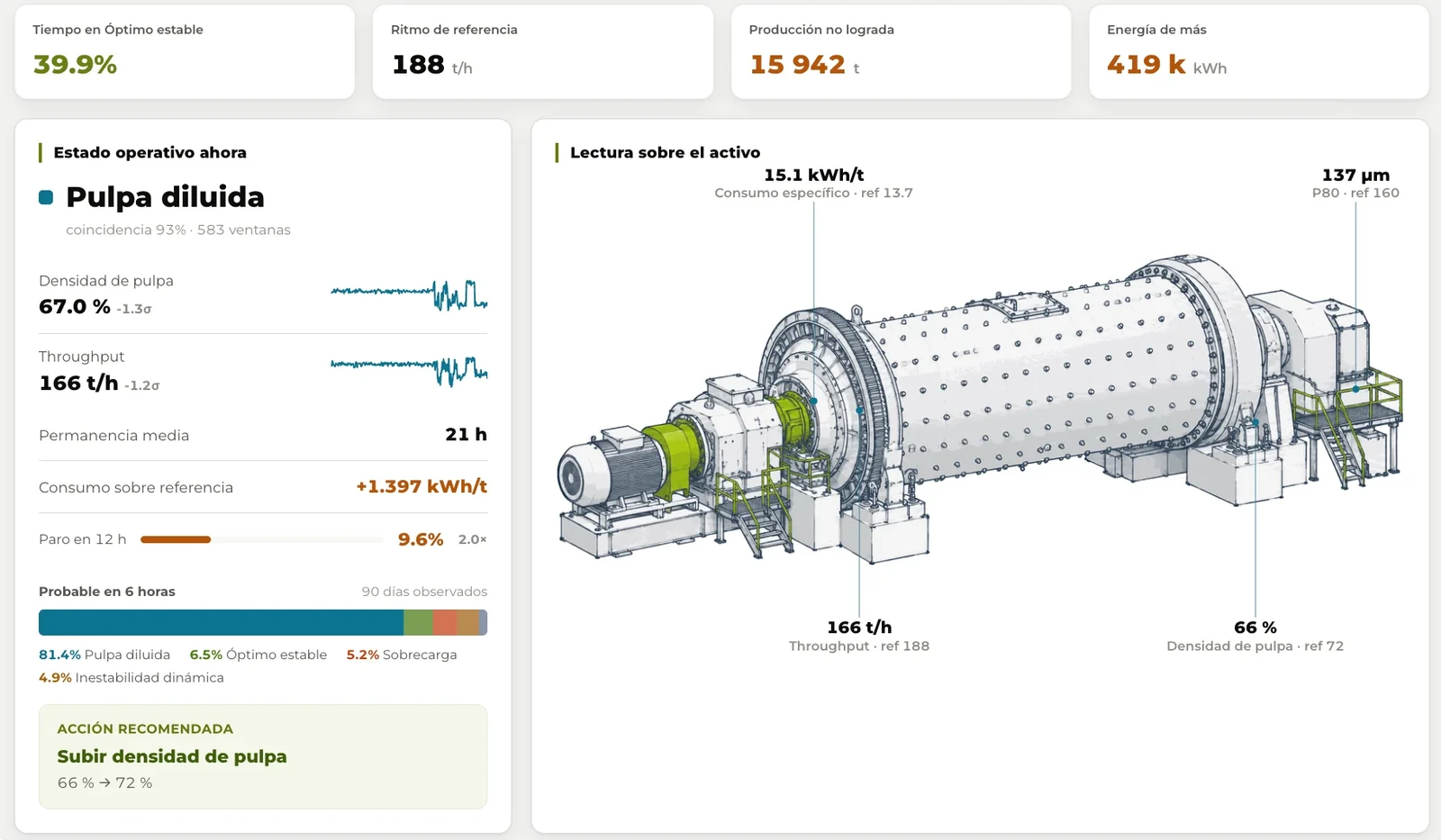
The algorithm finds the states in the process history, and the plant team validates them.
Read the full Firma Operativa guide
Why it matters now
Industry is going through a deep shift: producing predictably has become as important as producing more. The latest EY and McKinsey studies show it clearly in mining and materials, and the same pressures are felt across the process industries: geopolitical and trade tensions, rising raw material and energy costs, and a shortage and turnover of operating talent.
- No. 1
Operational complexity is the top risk and opportunity for mining in 2026: declining ore grades, deeper orebodies and aging assets.
EY, Top 10 business risks and opportunities for mining and metals in 2026 - ~40%
Decline in the average grade of copper mined worldwide since 1991.
EY, 2026 - 28%
Of mining executives point to processing plant capacity as a bottleneck; ore variability pulls it away from design capacity.
EY, 2026 - USD 450–750 billion
Annual productivity potential in metals and mining (15–25% of revenues). Most of it, USD 300–475 billion, lies in operational excellence: throughput, recovery and costs.
McKinsey, Global Materials Perspective 2026 - 28–36%
Increase in unit costs for copper, gold and iron ore since 2020, above US inflation (24%).
McKinsey, Global Materials Perspective 2026 - +5%
Throughput gained by a copper producer through machine learning optimization, with almost no new capital investment.
McKinsey, Global Materials Perspective 2026
Although these studies focus on mining and materials, their causes are common to any industrial operation. The same EY report ranks rising costs (No. 2), workforce (No. 6) and geopolitics (No. 7) among the sector's top risks, pressures that cement, food, chemical and manufacturing plants also face today: more variable processes, more expensive inputs and fewer experienced people to run them.
EY recommends restoring predictability by aligning planning with execution, and McKinsey notes that the advantage will go to those who take AI from pilots to production systems with clear KPIs. That is where digital twins work: turning process variability into measurable decisions, shift after shift.
Edge Computing
Our work starts with access to industrial data. An Edge node at the plant captures signals from the installed base, adds context, runs models locally and keeps the data if the network goes down. Execution can happen at the plant or in the cloud, depending on the application.
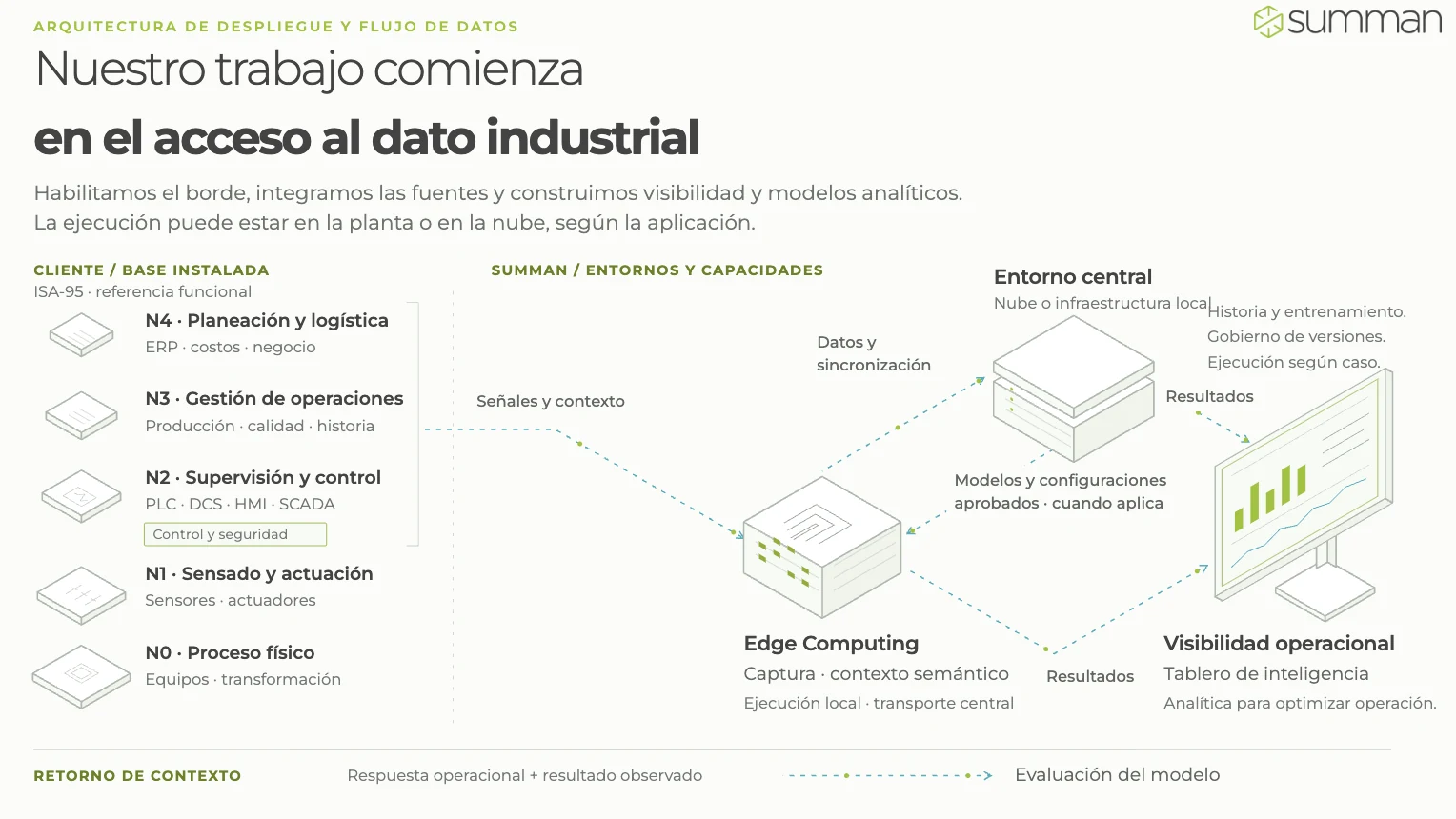
Explore the Edge Computing architecture
Unified Namespace
A Unified Namespace (UNS) is a common namespace where each source publishes its information once over MQTT, already governed and with context, and every system subscribes to what it needs. Models, dashboards and applications read the same data with the same meaning, without point-to-point integrations.
| The same signal | Without UNS | With UNS |
|---|---|---|
| Identity | A technical code only its creator understands | A clear name, placed in the plant structure |
| Context | Value and time | Meaning, unit and valid range |
| Quality and origin | Each system assumes them | They travel with the data |
| Consumption | Point-to-point integrations | One governed data point for everyone |
See how the data changes: from raw signal to governed data
Technologies
Industrial IoT, Edge Computing, Unified Namespace, machine learning in production and cloud platforms (Azure, AWS and Google Cloud), integrated with the plant's OT/IT systems under the ISA-95 standard and connected to multi-vendor equipment through open standards.
Digital twins in Latin America
A digital twin creates value in any operation with physical processes, variability and data. From Medellín, Colombia, we work with companies across the region, with on-site and remote teams. Some key sectors:
- Mining and metals
- Cement and building materials
- Energy and utilities
- Oil & gas
- Chemicals and petrochemicals
- Food and beverage
- Manufacturing
- Pulp and paper
- Agribusiness
- Logistics and infrastructure
We serve companies in Colombia, Peru, Chile, Argentina, Mexico, Guatemala, Panama, Nicaragua and Brazil.
Frequently asked questions
What is the difference between a digital twin and a simulation?
A simulation runs on fixed assumptions to study a scenario. A digital twin is connected to real operating data, updates continuously and delivers recommendations on the process as it is running today.
What data is needed to build a digital twin?
Usually historical and live data from process variables (sensors, DCS, PLC, SCADA or historians), lab and quality results, and production data. During the Assessment we evaluate what data exists, its quality and what is missing.
How long does it take to implement a digital twin?
It depends on the process, the available data and each plant's infrastructure. The Journey starts with a focused assessment and prototype, and each phase is validated before moving forward, so time and investment are clear from the start.
Does the digital twin work with existing control systems?
Yes. The digital twin integrates with existing systems (DCS, PLC, SCADA, historians and ERP) and delivers recommendations on top of them, building on the investment the plant already has.
What return can be expected?
It depends on the process and data maturity. As a reference, the Cementos Argos digital twin generates savings of more than USD 12 million per year, with higher production and lower energy use and emissions.
Does Summan work with companies outside Colombia?
Yes. We serve companies in Colombia, Peru, Chile, Argentina, Mexico, Guatemala, Panama, Nicaragua and Brazil, with on-site and remote teams.
Updated: