# Bring data processing to your plant.
> Edge processing for industry: we capture data at the plant with its context, run models close to the process and keep operating even without a connection.
URL: https://www.summan.com/en/solutions/digital-twins/edge-computing/
:::html
- Data with context
- Models close to the process
- Runs offline
The challenge
Sound familiar?
- 01Signals that reach the cloud as loose numbers, without context
- 02Historical analysis instead of a synchronized operation
- 03Applications that stop when the network goes down
- 04Concern about touching the control system to get the data
With Edge Computing
Data capture, validation and analysis happen at the plant itself, close to the equipment. Industrial data becomes reliable, contextualized and available at the right moment.
Architecture
From the physical process to operational visibility
:::
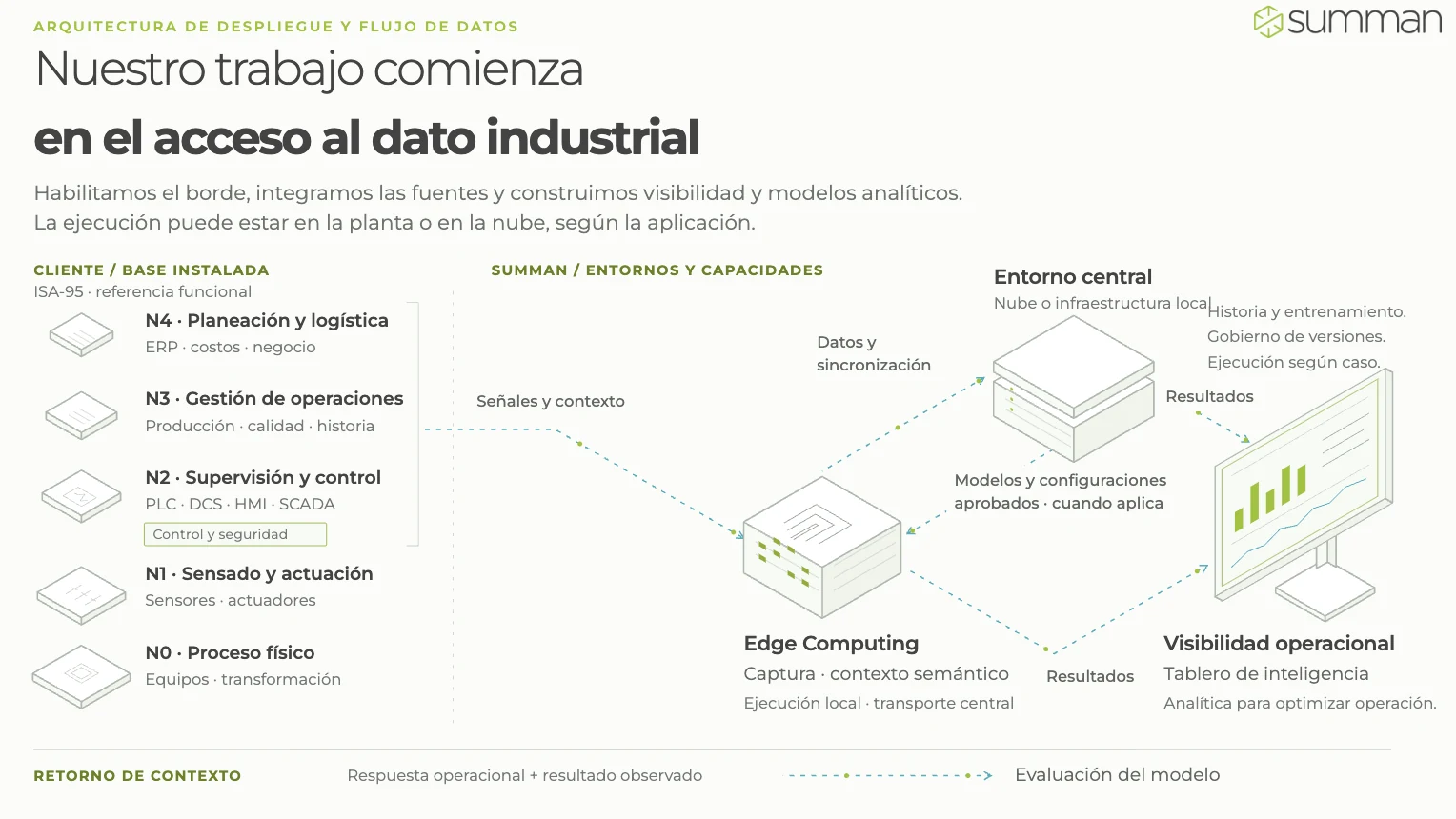
The architecture starts from each plant's **installed base**, organized according to the **ISA-95** standard: from the physical process and sensors up to control, operations management and business systems. The cycle closes with **context feedback**: what the operation does and what results from it flow back into the system so the models improve over time.
:::html
:::
:::html
Three layers
On top of your installed base, three layers
- 01
Edge Computing
At the plant: captures signals with their context and runs models close to the process.
- 02
Central environment
In the cloud or on-premises: stores history and trains and governs the models.
- 03
Operational visibility
Dashboards and intelligence to optimize the operation.
Benefits
Reliable data, right when you need it.
- Results at the right moment, close to the equipment.
- Data is kept at the plant if the network goes down, and local models keep running.
- Secure, read-only access: the control system stays intact.
- In the cloud, on-premises or hybrid.
- Built on the installed base, starting with an assessment of each plant.

We work with Barbara, an industrial edge computing platform, as our technology partner to deploy and manage nodes at the plant.
How it connects to the digital twin
The edge is the foundation of the Digital Shadow stage: with online integration, the twin moves from historical analysis to a synchronized reading of the plant.
Firma Operativa models are trained in the central environment and run close to the process. Explore the Journey to Digital Twin and the Unified Namespace.
Start with access to industrial data.
With an assessment we define the safest way to connect each plant.
Request an assessment
:::
:::html
:::
## Frequently asked questions
### What is industrial edge computing?
It means processing operating data at the plant, close to the equipment: capturing it, validating it, adding context and running models locally, to deliver results at the right moment and keep operating even without a cloud connection.
### Is the PLC or control system modified?
The solution reads data securely, in observation mode, and leaves control intact. Any action on control is designed separately, with testing, change management and explicit authorization from operations.
### What happens if the network goes down?
Data is kept at the plant and sent when the connection returns. Meanwhile, applications and local models keep running.
### Does it work in the cloud or on-premises?
Both, or in a hybrid model. The solution adapts to each client's infrastructure and data governance.
### Do we need to change instrumentation or the control system?
The architecture builds on the installed base. We start with an assessment to define the safest way to connect each plant.
:::html
:::